
1. Introduction
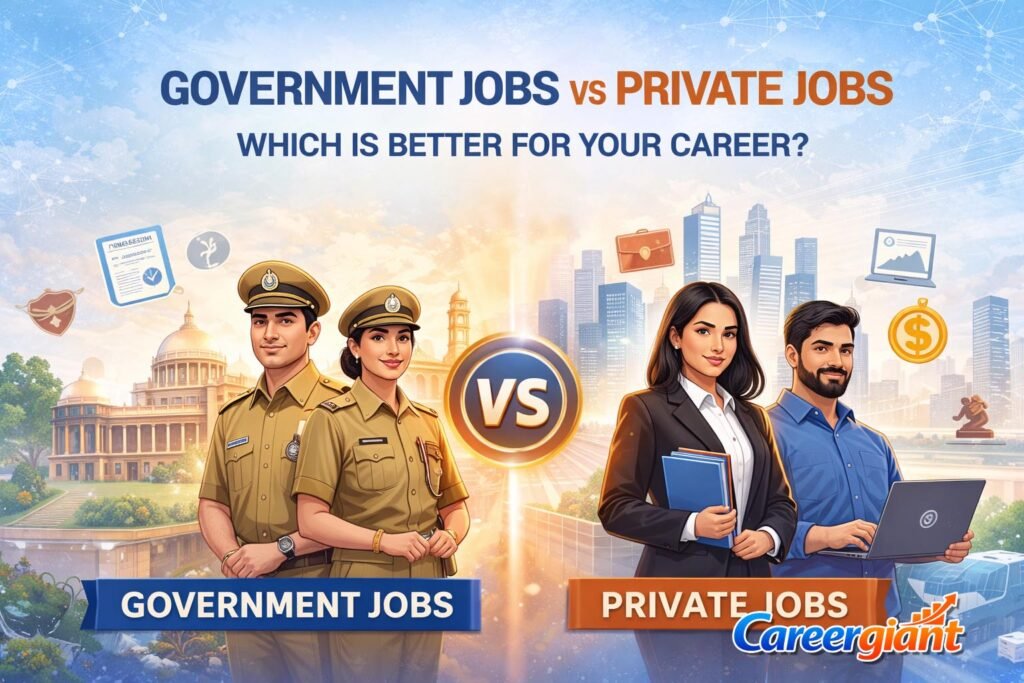
Choosing between a government job and a private job is one of the biggest career decisions for students and job seekers in India. For decades, government jobs have been considered the most secure and prestigious career option, while private jobs are often associated with higher salaries, faster growth, and dynamic work environments.
With the changing economic landscape, digital transformation, and globalization, the gap between these two sectors has evolved significantly. Today, both government and private jobs offer unique advantages and challenges.
This detailed guide will help you understand the differences between government and private jobs, their benefits, drawbacks, and which option might be better suited for your career goals.
2. Understanding Government Jobs
2.1 What Are Government Jobs?
Government jobs are positions offered by central, state, or local government organizations. These include roles in civil services, public sector undertakings (PSUs), banking, railways, defense, and education.
Examples of government job sectors include:
- Civil Services (IAS, IPS, IFS)
- Banking (SBI, RBI, IBPS)
- Railways
- Defense Services (Army, Navy, Air Force)
- Public Sector Companies (ONGC, BHEL, NTPC)
2.2 Nature of Work
Government jobs generally involve administrative, operational, or public service-related tasks. The work is often structured and follows established procedures.
3. Advantages of Government Jobs
3.1 Job Security
One of the biggest advantages of government jobs is job security. Once you secure a government position, the chances of losing your job are very low, provided you follow rules and regulations.
This stability makes government jobs highly attractive, especially for individuals seeking long-term security.
3.2 Work-Life Balance
Government jobs usually have fixed working hours, allowing employees to maintain a healthy work-life balance. Overtime is rare, and leaves are well-structured.
3.3 Benefits and Perks
Government employees enjoy numerous benefits such as:
- Pension schemes
- Medical facilities
- Housing allowances
- Travel allowances
- Paid leaves
These benefits add significant value beyond salary.
3.4 Social Status and Respect
Government jobs are often associated with prestige and respect in society, especially roles like IAS, IPS, and other administrative services.
3.5 Retirement Benefits
Government jobs provide post-retirement benefits such as pensions, ensuring financial stability even after retirement.
4. Disadvantages of Government Jobs
4.1 Limited Growth Opportunities
Promotions in government jobs are often based on seniority rather than performance, leading to slower career growth.
4.2 Competitive Exams
Securing a government job requires clearing highly competitive exams such as UPSC, SSC, or banking exams. These exams require years of preparation and dedication.
4.3 Salary Limitations
Compared to private sector jobs, salaries in government jobs may be lower, especially in the early stages of a career.
4.4 Less Exposure to Innovation
Government jobs may involve repetitive tasks with limited exposure to new technologies or innovation.
5. Understanding Private Jobs
5.1 What Are Private Jobs?
Private jobs are offered by privately owned companies, startups, and multinational corporations. These include roles in IT, finance, marketing, manufacturing, and more.
5.2 Nature of Work
Private sector jobs are dynamic, performance-driven, and often require adaptability. Employees are expected to meet targets and contribute to business growth.
6. Advantages of Private Jobs
6.1 High Salary Potential
Private jobs often offer higher salaries compared to government jobs, especially in industries like IT, finance, and consulting.
6.2 Faster Career Growth
Promotions in private companies are based on performance. Talented individuals can grow quickly and reach leadership positions in a shorter time.
6.3 Skill Development
Private jobs provide opportunities to learn new skills, work with advanced technologies, and gain global exposure.
6.4 Diverse Opportunities
The private sector offers a wide range of career options across industries, allowing individuals to explore different roles and domains.
6.5 Innovation and Creativity
Private companies encourage innovation and creativity, making work more engaging and challenging.
7. Disadvantages of Private Jobs
7.1 Job Insecurity
Private jobs are less stable compared to government jobs. Employees may face layoffs due to economic downturns or company performance.
7.2 Work Pressure
Private sector jobs often involve high pressure, deadlines, and long working hours.
7.3 Limited Benefits
While salaries may be higher, benefits like pensions and job security are often limited.
7.4 Work-Life Imbalance
Long working hours and high expectations can lead to poor work-life balance.
8. Key Differences Between Government and Private Jobs
8.1 Job Security
Government jobs offer high security, while private jobs carry some risk.
8.2 Salary
Private jobs generally offer higher salaries, especially in the early and mid-career stages.
8.3 Growth
Private jobs provide faster growth, whereas government jobs have slower promotion cycles.
8.4 Work Environment
Government jobs are stable and structured, while private jobs are dynamic and competitive.
8.5 Benefits
Government jobs offer better long-term benefits, including pensions and allowances.
9. Which One Should You Choose?
9.1 Choose Government Job If:
- You prioritize job security
- You prefer a stable and predictable career
- You value work-life balance
- You are willing to prepare for competitive exams
9.2 Choose Private Job If:
- You want higher salary and faster growth
- You enjoy challenges and dynamic work
- You want to develop diverse skills
- You are comfortable with some level of risk
10. Hybrid Approach
10.1 Switching Careers
Many individuals start in private jobs to gain experience and later prepare for government exams.
10.2 Skill-Based Careers
With the rise of freelancing and remote work, professionals can also explore hybrid career paths.
11. Future Trends in India
11.1 Digital Transformation
Technology is impacting both government and private sectors, creating new opportunities.
11.2 Startup Ecosystem
India’s startup ecosystem is growing rapidly, offering exciting career options in the private sector.
11.3 Government Reforms
Government initiatives are improving efficiency and creating new job opportunities.
12. Conclusion
12.1 Final Thoughts
Both government and private jobs have their own advantages and challenges. There is no one-size-fits-all answer.
The best choice depends on your personal preferences, career goals, risk tolerance, and lifestyle expectations.
If you value stability and security, government jobs may be the right choice. If you seek growth, innovation, and higher earnings, private jobs might be more suitable.
Ultimately, success depends on your dedication, skills, and ability to adapt to changing circumstances.